
When an import program shifts from showroom samples to container bookings, a compressed sofa offer only becomes useful if the supplier can prove the package math behind it. For buyers reviewing a compressed sofa in a box program, that means comparing live product specifications, foam options, carton dimensions, rebound standards, and the factory controls that keep repeat orders consistent. A sofa in a box compressed concept can reduce freight pressure, but only when the sourcing file ties product fit, packing method, and container loading data to the same approved model list.

Which product mix should import teams define before requesting pricing?
The first step is to decide whether the order needs lounge seating, sleeper capacity, or a mixed program. The live compressed sofa collection is useful because it shows that a compressed line can cover standard lounge formats, larger daybed concepts, and export-ready sleeper models instead of one generic SKU. Buyers should decide early whether the brief is for retail replenishment, apartment furnishing, project supply, or a mixed-channel launch, because those scenarios change the practical carton plan.
For a compressed foam sofa RFQ, import teams should lock:
- which models are core volume items and which are trial SKUs
- whether the target market needs lounge seating, sofa bed use, or both
- the receiving warehouse limits for carton weight, carton size, and stack height
- whether cartons must be retail-ready with labels, inserts, and warning marks
- whether the first PO is a single-container test or a repeat import program
Without those decisions, the buyer cannot compare one supplier’s freight promise with another supplier’s actual packing method.
What live model specifications matter most in a compressed sofa in a box review?
The LS1016 folding sofa bed gives a clear benchmark for a compressed sofa bed program because the current page lists product size 200 x 85 x 70 cm, flat size 200 x 215 x 70 cm, packing 112 x 34 x 35 cm, checked velvet fabric, 29.5 kg gross carton weight, 1 piece per carton, 0.133 CBM per carton, and an estimated 503 units per 40HQ. Those specification lines matter more than a broad freight claim because they affect receiving labor, warehouse slotting, and the landed-cost model for every repeat order.
The compressed sofa vacuum pack shipping model adds the broader logistics baseline. The live product copy says the program targets importers, distributors, project buyers, and private-label accounts using vacuum-compressed roll-pack packaging with 60% CBM reduction versus conventional assembled sofas, up to 2.5x more units per 40HQ, and a rebound rate of at least 95% within 72 hours after unpacking. That combination makes the product page useful as a decision reference, not just a sales page.
How should buyers compare carton data, loading math, and freight assumptions?
The container loading page is the most important cross-check because it explicitly says loading capacity depends on the confirmed carton size and model, and that buyers should not reuse one generic quantity across different sofas. The page also publishes model-based loading references, including LS1016 at 210 pieces for 20GP and 503 pieces for 40HQ, plus carton dimensions and CBM. That is the correct standard for a buying guide: one model, one loading calculation.
Import teams should ask suppliers to show:
- the approved carton dimensions for each quoted model
- whether the 20GP and 40HQ quantities are based on carton loading or bulk-bag packing
- the gross weight per carton and who verifies it before shipment
- whether the quoted container plan changes after fabric or size adjustments
- how much storage space the receiving warehouse needs for the first batch
That review protects buyers from treating a sofa compressed offer as equivalent across every model when the CBM, loading quantity, and unloading effort can change materially.
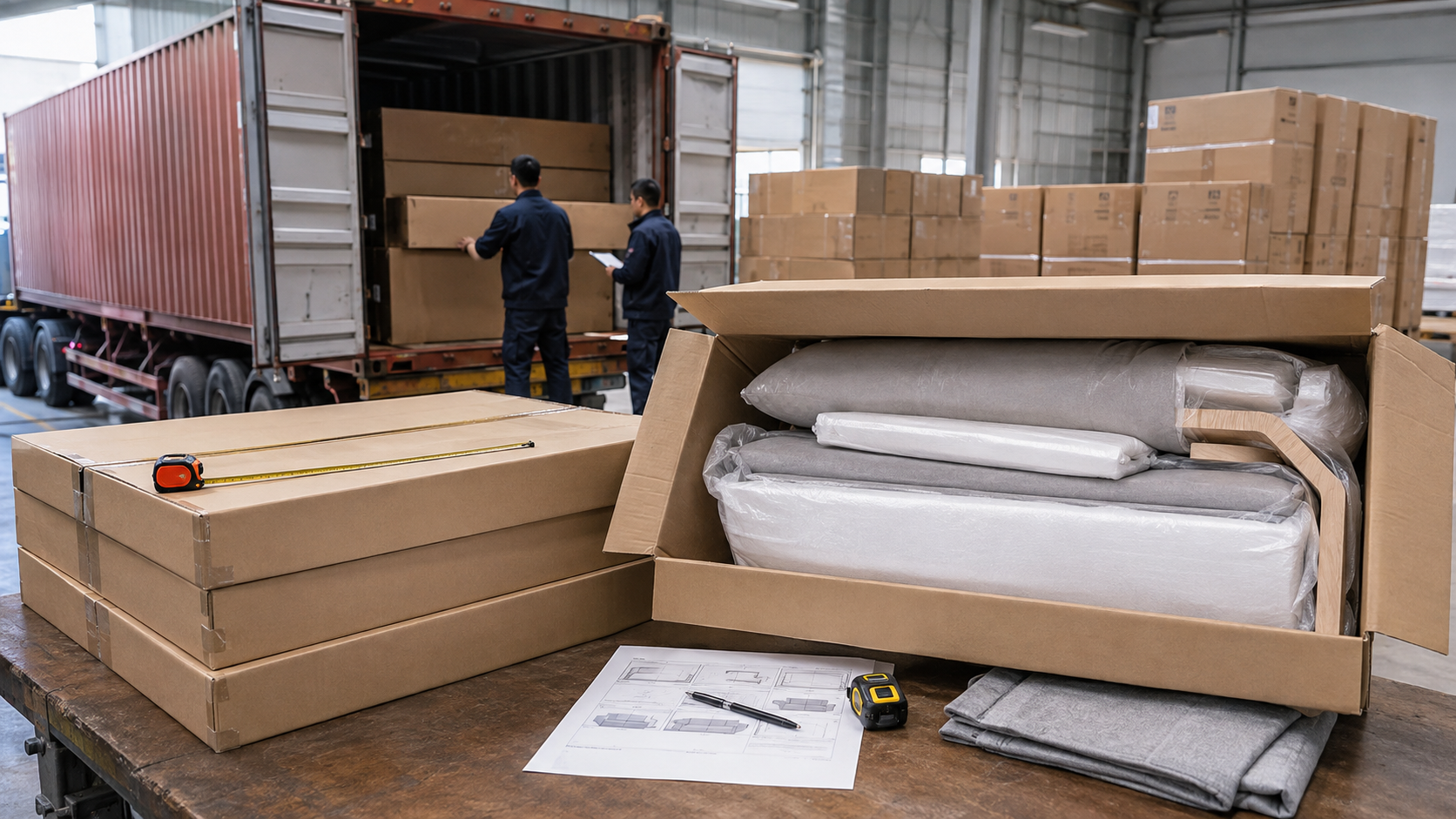
| Buyer checkpoint | Current live detail | Why it matters for import execution |
|---|---|---|
| Product size | LS1016 shows 200 x 85 x 70 cm and 200 x 215 x 70 cm flat mode | Confirms the use case before the container plan is approved |
| Packing data | LS1016 lists 112 x 34 x 35 cm, 29.5 kg, and 0.133 CBM | Drives carton handling, warehouse space, and landed cost |
| Loading reference | Container page lists LS1016 at 210 units for 20GP and 503 units for 40HQ | Keeps freight comparison tied to a real model calculation |
| Recovery standard | Vacuum-pack model cites at least 95% rebound within 72 hours | Helps buyers set unpacking and launch timing expectations |
Which material and rebound details deserve extra scrutiny before PO approval?
Buyers often focus on dimensions first, but material details decide whether the recovery result matches the sample. The LS1016 page currently identifies checked velvet fabric, while the vacuum-pack shipping model describes high-density foam with upholstered fabric cover. A related curved-back compressed daybed on the current site also shows selectable widths from 1.0 m to 2.2 m with 50D high-elastic foam or 55D high-resilience foam, which is useful evidence that foam density and format should be confirmed by model instead of assumed across the whole program.
For a compressed sofa in a box sourcing review, practical checks should include:
- whether the final upholstery changes the compression method or rebound speed
- whether the supplier can document rebound photos after 24, 48, and 72 hours
- whether the approved foam density matches the target comfort profile and market
- whether carton protection is sufficient for long-distance export handling
- whether the final bill of materials matches the product specification used for quotation
These are the details that separate a usable import program from a low-price quotation with weak recovery performance.
What factory and OEM controls should a supplier prove before deposit?
The OEM and ODM page shows the operational scope buyers should expect: fabric selection, color planning, size adjustment, private-label branding, carton customization, instruction manuals, compression packaging review, and e-commerce packaging support. It also lays out a process sequence from requirement confirmation to design review, sample, testing, mass production, inspection, and shipping. That workflow matters because a strong compressed sofa supplier should control branding, packaging direction, inspection, and loading preparation as one process.
Before deposit, an import team should confirm:
- who signs off the final model specification and carton design
- whether label, barcode, manual, and insert execution are handled in-house
- how the factory reviews compression recovery, packaging protection, and inspection
- whether MOQ changes when the buyer mixes models or adds OEM packaging requirements
- how production schedule and loading preparation are documented before shipment
For destination-market compliance review, teams shipping into the United States can align their product-safety and labeling checks with CPSC guidance while final materials and market requirements are being confirmed.
What should the final RFQ package include before sending the inquiry?
A complete sourcing file should connect the chosen models, packaging method, and shipment plan before the buyer asks for the final quotation. The best closing step is to send the destination port, quantity split, customization scope, and loading expectation through the MagiSofa contact page only after the commercial team has matched the correct model list to the container plan. That avoids generic email exchanges that never reconcile product parameters with shipping execution.
The minimum RFQ pack should contain:
- selected model names and target quantities
- required product dimensions, material direction, and foam expectations
- carton size limits, gross-weight limits, and preferred packing method
- 20GP or 40HQ planning assumptions for the first order
- OEM or private-label packaging requirements
- target market, delivery deadline, and unloading constraints
When those details are tied back to live product pages, live loading references, and documented factory controls, buyers can compare suppliers on shipment readiness instead of only on headline price.
Review your import RFQ
Send your model mix, destination port, and carton limits for a compressed sofa in a box quotation backed by live specs, loading math, and OEM packaging review.