
A compressed sofa in a box quote can look convincing when the unit price, finished dimensions, and fabric name fit the brief. Those fields do not show whether the sofa will recover consistently, whether the carton will survive export handling, or whether the factory can hold the approved construction through mass production. Furniture importers need evidence that connects the sample, packing specification, inspection plan, and container calculation.
Start with the compressed sofa collection to define the correct product family, then compare suppliers through one controlled request-for-quotation sheet. A low price is useful only when every bidder is pricing the same construction, packaging, quality checkpoints, and delivery responsibility.
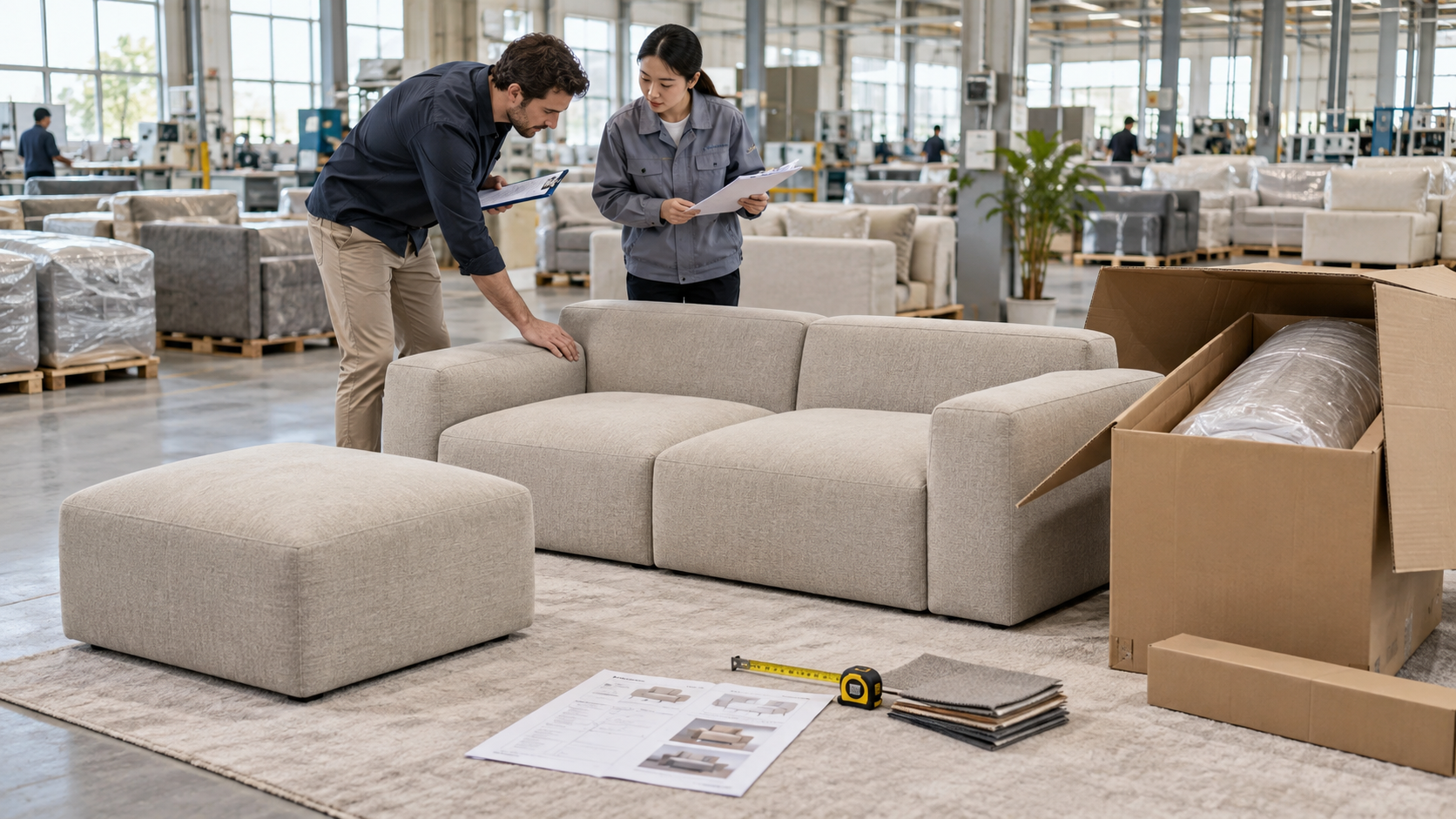
Why do similar quotations create different landed costs?
Two suppliers can quote the same finished size while using different foam density, firmness tolerance, cover weight, seam construction, inner protection, carton grade, and compressed-storage limit. Those differences affect recovery time, usable life, carton damage, handling labor, and claim risk.
Ask each supplier to separate product cost, private-label packaging, testing, inspection, spare covers or units, inland transport, and export documentation. Then calculate landed cost per usable seat instead of comparing only factory price. Include ocean freight, destination handling, recovery space, assembly or placement labor, damage allowance, and the cost of replacements arriving after the selling season.
Which product parameters need physical verification?
The request-for-quotation sheet should state finished width, depth, height, seat height, seat depth, net weight, gross weight, foam density, firmness range, cover composition, removable-cover construction, connector details, and recovery target. Dimensions should include an agreed measurement tolerance and a drawing that identifies the measurement points.
The LS1016 folding compressed sofa bed provides a published model reference: 200 x 85 x 70 cm in sofa mode, 200 x 215 x 70 cm when opened, a 112 x 34 x 35 cm carton, and 29.5 kg gross weight. Use those figures only for that model and confirm them against the approved sample and final packing sheet before ordering.
| Evidence item | What to record | Buyer decision |
|---|---|---|
| Finished sample | Size, seat height, seat depth, weight | Confirm room fit and handling method |
| Foam and cover | Density, firmness tolerance, composition, GSM | Approve comfort, durability, and cleaning basis |
| Recovery trial | Measurements at opening, 24, 48, and 72 hours | Set an acceptance limit and corrective action |
| Production carton | Packed size, gross weight, protection, marks | Confirm warehouse and transport compatibility |
| Loading plan | SKU count, orientation, voids, total CBM | Approve freight budget and loading sequence |
How should recovery and material claims be tested?
A compressed foam sofa must be tested after realistic storage and transport conditions, not only immediately after packing. Use a production-representative sample, record compression date and storage duration, then photograph and measure it at opening and at agreed intervals. Check seat height, corners, back profile, seams, wrinkles, odor, and permanent deformation.
The vacuum-pack shipping model describes high-density foam, upholstered covers, vacuum-compressed roll packing, up to 60% CBM reduction, and at least 95% recovery within 72 hours. These are model-level published claims, not universal guarantees. Put the ordered model’s target, test method, conditioning period, and remedy for failure into the signed specification.
Approve physical fabric and foam samples with traceable codes. Record fabric composition, weight, abrasion and colorfastness test basis, zipper and seam construction, foam density, and firmness tolerance. For US-bound programs, use CPSC guidance as an authority starting point while the importer confirms every applicable flammability, labeling, and market requirement for the final product.
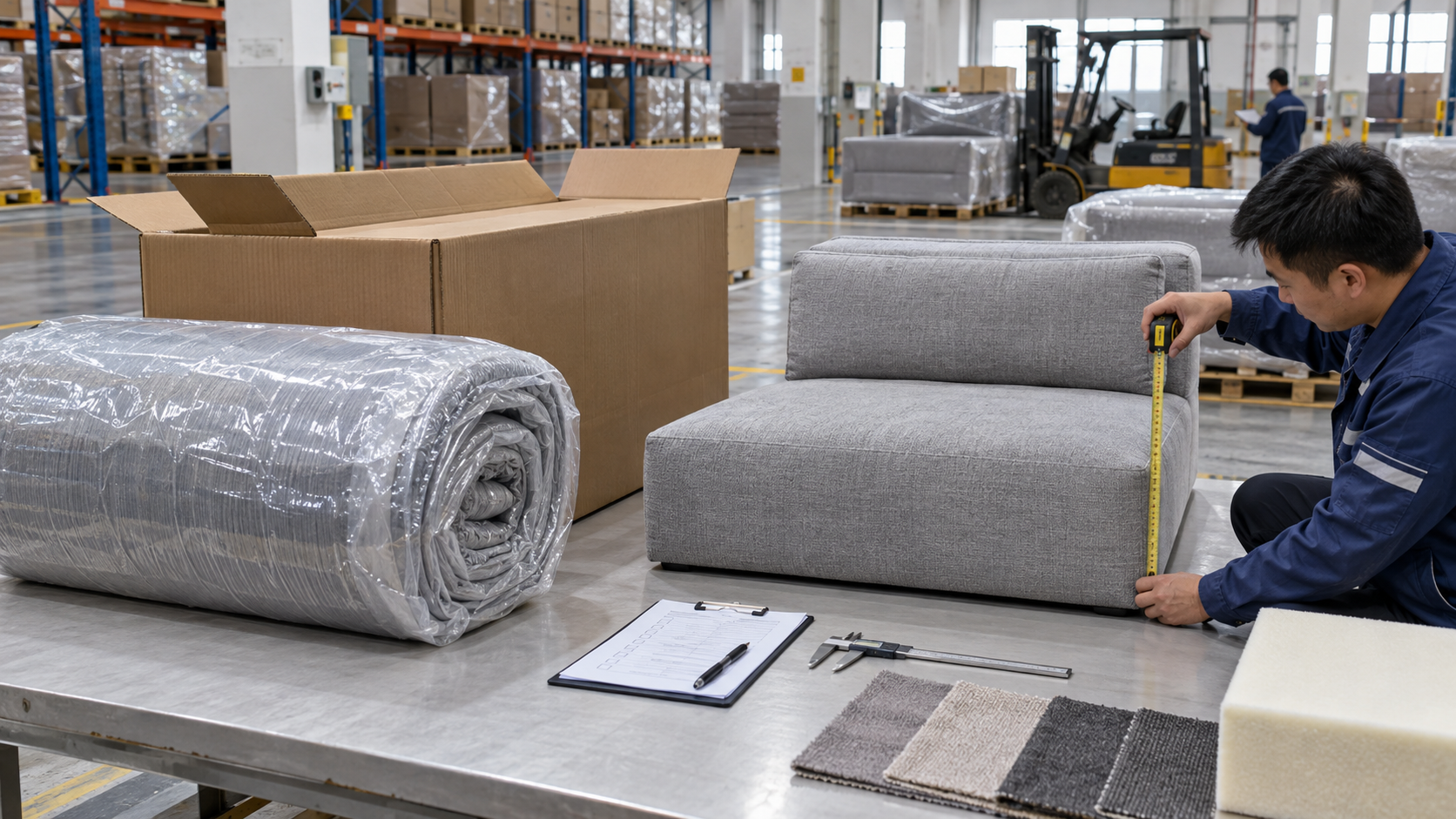
What packaging evidence should be approved before production?
Specify whether the sofa in a box compressed format is rolled or folded, the inner moisture barrier, abrasion protection, corner protection, carton board grade, sealing method, carton dimensions, gross weight, barcode position, spare-part location, and maximum compressed-storage period. The purchase order should also state the unpacking instructions and required warning labels.
Request one production-standard carton before mass packing. Run a drop and handling review appropriate to the distribution route, then open the carton and repeat the recovery test. Verify that warehouse staff can scan the label without rotating the carton and that the package fits pallet, rack, vehicle, doorway, lift, and last-mile constraints.
For mixed-SKU orders, require color, model, destination, and sequence codes on both the carton and packing list. This reduces mis-picks and prevents installers from opening cartons merely to identify their contents.
Which factory controls matter beyond a capability claim?
The MagiSofa OEM and ODM process describes customization, sampling, material selection, private-label packaging, production, testing, inspection, and shipping. A buyer should turn those capabilities into named gates: signed specification, golden sample, approved bill of materials, material booking, pre-production meeting, first-piece approval, inline inspection, final random inspection, recovery test, and loading supervision.
Ask which production line will make the order, planned daily capacity, current workload, subcontracting scope, material-lot traceability, and who can stop production when a variance appears. The inspection checklist should define sample size, defect classes, tolerance, photo evidence, rework responsibility, and reinspection timing.
Do not release the balance only because cartons are finished. Link payment approval to the agreed inspection result, packing evidence, shipment documents, and corrective-action closure.
How can buyers verify container loading rather than estimate it?
The container-loading reference lists 210 LS1016 pieces in a 20GP and 503 pieces in a 40HQ, based on the published 0.133 CBM carton. These figures are useful for that model only. Any change in model, carton, accessories, color split, spare quantity, or loading orientation requires a fresh calculation.
Require a SKU-level plan showing carton dimensions, unit CBM, gross weight, quantity, orientation, layer count, door clearance, void allowance, moisture protection, and loading sequence. Compare total carton CBM with the physical layout; theoretical division by container volume ignores unusable spaces and operational clearance.
Loading photos should show the empty container condition, moisture controls, first rows, intermediate rows, final rows, door area, seal number, and carton marks. Reconcile the photographed count with the packing list before shipment approval.
What should be locked before issuing the purchase order?
The final approval file should contain the signed product drawing, golden sample record, material codes, test reports, production carton, recovery protocol, inspection standard, packaging artwork, loading plan, schedule, Incoterm, payment gates, and named contacts. Version numbers matter: the factory, inspection company, and buyer must use the same revision.
Use this release sequence:
- approve the finished product and material samples;
- approve the production-standard carton and recovery evidence;
- approve the bill of materials and factory quality gates;
- approve the SKU-level loading plan and landed-cost calculation;
- align inspection, document, payment, and shipment milestones;
- send the controlled brief through contact MagiSofa.
Review Your Compressed Sofa Sourcing File
Share your model mix, destination, material targets, carton limits, and order timing for a practical specification and container-loading review.