
A compressed sofa quote can look complete while leaving the buyer exposed to carton growth, slow foam recovery, fabric substitutions, and container shortfalls. Furniture importers should therefore qualify the product, packing method, and evidence trail together. A low unit price does not protect margin if the production carton is larger than the quoted carton, if a sofa compressed for too long fails to recover, or if a mixed-SKU load cannot be built as planned.
The MagiSofa compressed sofa collection includes different seating formats and packing approaches. Treat every SKU as a separate logistics case: record its finished dimensions, materials, compressed dimensions, gross weight, recovery method, and loading orientation before approving a commercial forecast.

Separate product approval from packing approval
The showroom sample proves only the finished product configuration presented for review. Packing approval requires another evidence set. Define the model number, finished width, depth, height, seat height, seat depth, foam density and layer thickness, upholstery composition, color code, seam construction, accessories, labels, and instructions. Freeze those details in a revision-controlled specification and signed sample.
Then document the exact compression process: inner bag, vacuum level or roll method, protective wrap, compression date, maximum packed-hold time, export-carton grade, sealing method, and storage conditions. A compressed foam sofa can pass appearance review before packing but behave differently after days or weeks under compression. That difference is why buyers should approve both the finished sofa and the packing method.
Measure a production carton instead of trusting a nominal value
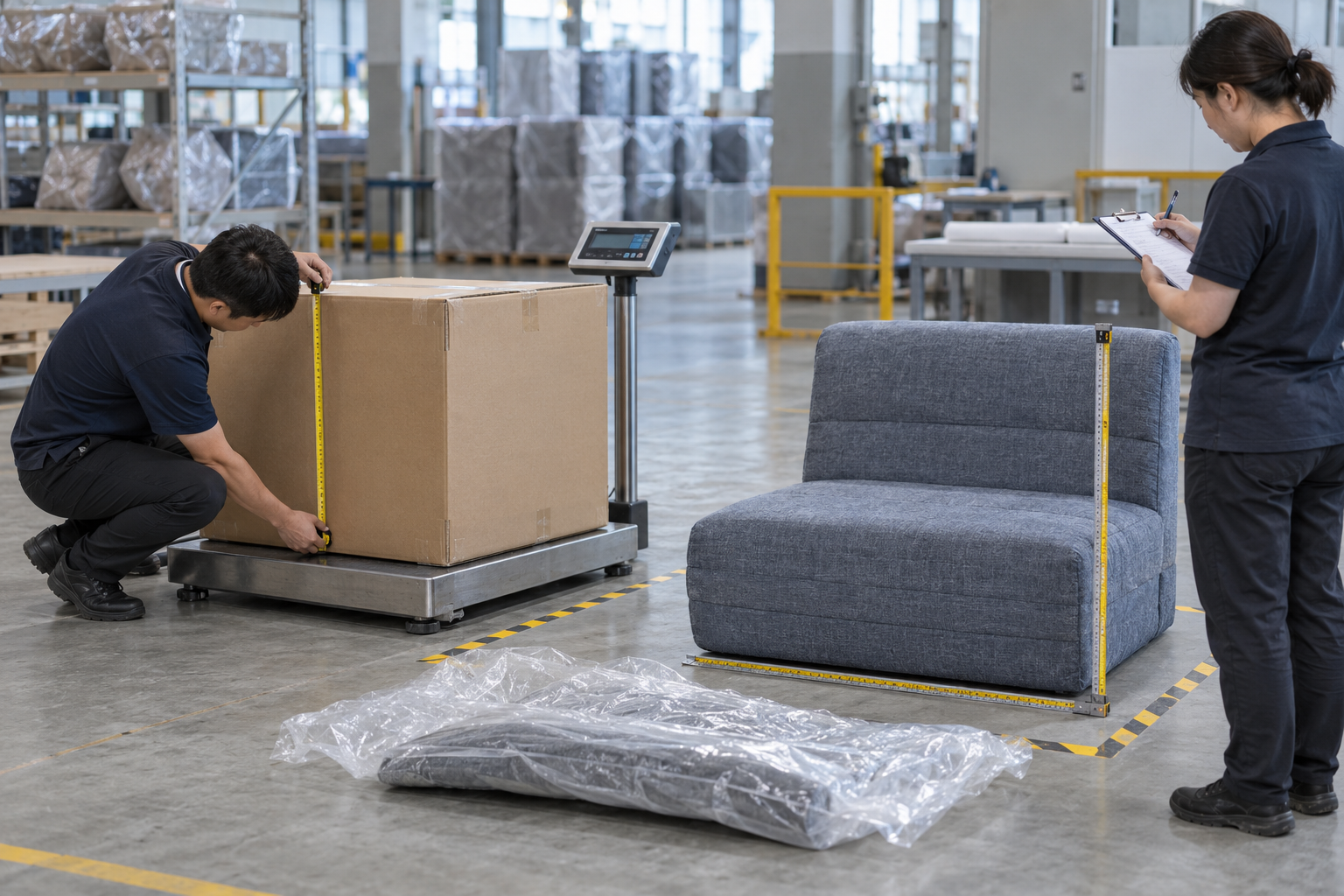
Ask the factory to pack random production units with the actual fabric, foam, accessories, carton artwork, and protective materials. Measure carton length, width, height, and gross weight after the agreed hold period. Photograph the tape and scale readings, carton condition, labels, and unit serial or batch reference so the measurements can be tied to the inspected lot.
The LS1016 folding compressed sofa bed publishes a 112 × 34 × 35 cm carton, 29.5 kg gross weight, and 0.133 m³ carton volume for its stated configuration. Those figures are useful model-level parameters, not a universal promise for every compressed sofa bed. Recheck the ordered fabric, accessories, construction revision, and carton before using them in freight calculations.
| Verification point | Evidence to collect | Commercial risk controlled |
|---|---|---|
| Finished sofa | Signed sample, dimensions, fabric and foam codes | Product substitution or size drift |
| Compressed unit | Packing date, method, packed profile | Excess compression or inconsistent process |
| Export carton | Measured L × W × H, gross weight, carton grade | Freight and handling variance |
| Recovery test | Time-stamped dimensions and photos | Shape, comfort, and claim risk |
| Trial load | Orientation map, count, door clearance, photos | Container shortfall and rehandling |
Make recovery testing match the real shipping cycle
Opening one freshly packed sample is not enough. Set a packed-hold period that reflects production storage, port dwell, ocean transit, customs clearance, and destination warehousing. Open random units after that hold period and record appearance and dimensions at opening, 24 hours, 48 hours, and 72 hours or another written schedule agreed for the product.
Define acceptance tolerances before testing. Check finished width, depth, height, seat profile, back shape, seam alignment, wrinkles, odor, fabric damage, zipper function, and any support parts. Record the room temperature and handling method. If the recovery result fails, the corrective action may involve the foam specification, compression ratio, hold-time limit, inner packaging, carton restraint, or recovery instructions—not simply more waiting.
Convert carton evidence into a loading plan
Carton CBM is only the starting point. Usable container capacity depends on internal dimensions, door opening, carton orientation, stacking strength, weight distribution, mixed-SKU sequence, dunnage, and unloading order. Spreadsheet division can overstate capacity when cartons cannot be rotated through the door or when a stack exceeds its safe height.
The compressed sofa vacuum-pack shipping model describes vacuum-compressed roll packing and a reinforced outer carton. Verify those features on the ordered model. Use the MagiSofa container loading guide to structure a trial-load discussion, then compare the final count, SKU labels, loading photos, container number, seal number, and packing list before shipment release.
Audit the factory controls behind repeatable cartons
Repeatability depends on factory controls, not one successful sample. Review incoming foam and fabric inspection, lot traceability, material storage, cutting tolerances, compression-equipment settings, packing-station capacity, measuring-tool calibration, random-sample selection, nonconformance handling, and first-packed-first-shipped controls. Ask who can stop shipment when carton or recovery data falls outside the written tolerance.
For private-label programs, the MagiSofa OEM and ODM process can support discussions about materials, colors, labels, instructions, carton printing, and specification changes. Destination-market requirements still depend on the actual product and market. Buyers should confirm applicable rules with the relevant authority, such as the U.S. Consumer Product Safety Commission, and should not treat a generic supplier certificate as approval for every model or destination.
Release the order only when evidence agrees
Build one shipment file containing the signed sample, bill of materials, revision history, material records, packed dimensions, gross weights, recovery results, inspection report, trial-load plan, packing list, loading photos, container number, and seal number. The purchasing, quality, and logistics teams should review the same revision. A mismatch between any two documents should pause release until the effect on product quality, container utilization, delivery timing, and landed cost is understood.
Before issuing final approval, ask whether the production carton matches the quoted carton, the tested hold period matches the likely shipping cycle, the selected units were genuinely random, the recovery tolerances are written, and the final loading count is supported by a physical or defensible orientation plan. Importers can contact MagiSofa for a model-specific packaging review with target SKUs, quantities, destination, and delivery window.
Verify the Carton Before Booking Freight
Share your selected models and target quantities for a practical packaging, recovery, and container-loading review.