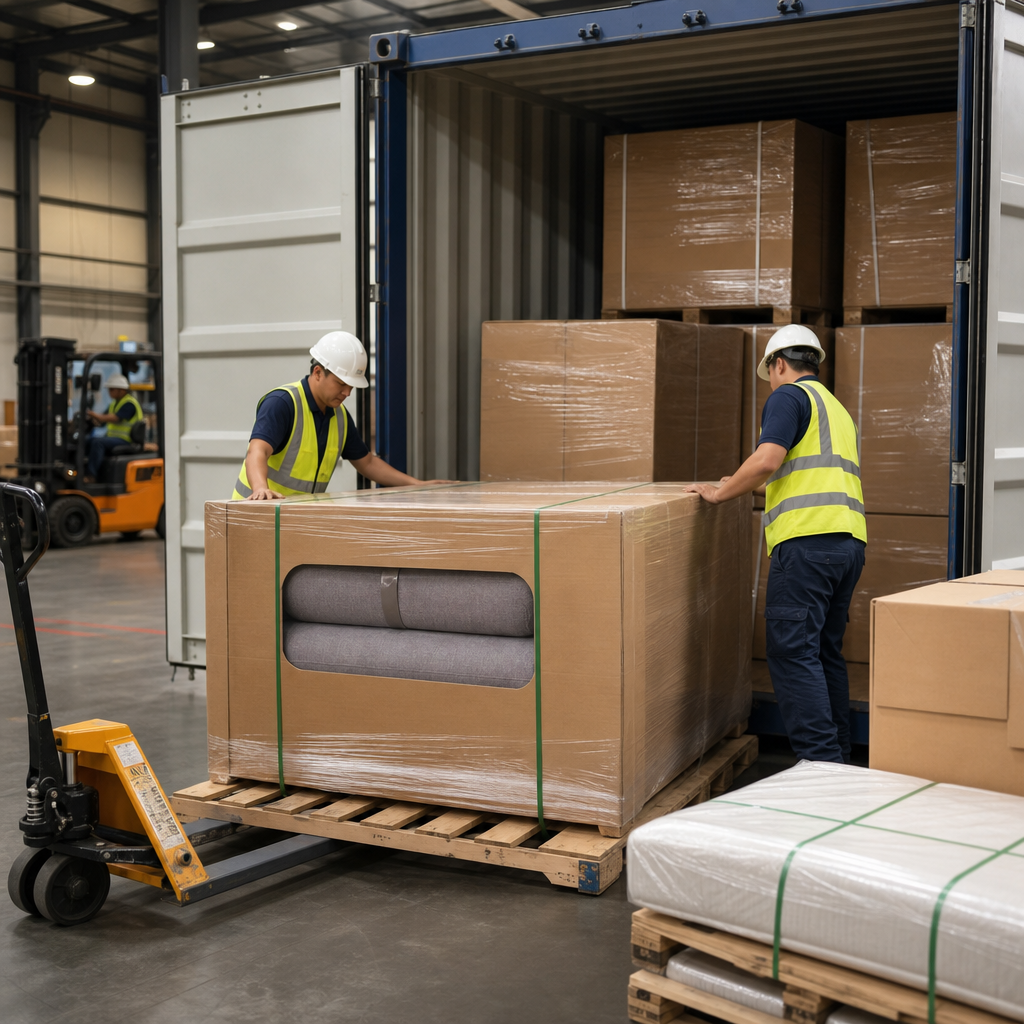
A compressed sofa can look simple on paper: dimensions, foam density, fabric swatch, carton size, and price. But for furniture importers, the real decision risk usually sits somewhere else—inside the packaging method, compression recovery, container loading efficiency, claims exposure, and post-arrival condition consistency. That is why buyers who keep comparing only unit price or basic specs often still end up with margin erosion, customer complaints, delayed launches, or poor sell-through.
If you source a compressed sofa in a box, the question is not just whether the sofa fits the catalog. The question is whether the full packaging-and-logistics system supports your commercial goals: lower landed cost, fewer defects, better warehouse handling, more reliable replenishment, and stronger confidence at retail.
Why datasheets alone do not protect the buyer
Most experienced importers have already learned this the hard way: a clean datasheet does not guarantee a smooth business outcome.
Two suppliers may show similar measurements, foam descriptions, and upholstery options. Yet one shipment performs well in the market, while the other creates avoidable friction across the supply chain. Why? Because the hidden variables are often operational:
- How stable is the compression process?
- How long can the product remain packed before recovery quality drops?
- Does the carton design reduce damage risk during handling?
- How efficiently do units load into a container?
- What happens when the sofa is unpacked after long transit?
- Are assembly steps clear enough to reduce returns and complaints?
- Does the package support e-commerce, retail distribution, or both?
For sourcing teams, this is the real issue: a cheaper FOB price can become an expensive program if it raises claims, slows receiving, wastes cube, or hurts customer satisfaction.
The real importer question: what are you trying to avoid?
A better buying framework starts with risk avoidance, not spec collection.
When buyers evaluate a sofa compressed for export, they are usually trying to avoid one or more of the following:
- Paying for unused container space
- Receiving goods that do not recover consistently after compression
- Damage during ocean transit or inland handling
- Unclear carton labeling and warehouse inefficiency
- Retail complaints caused by shape recovery, wrinkles, odor, or comfort inconsistency
- Replenishment delays from poor production planning
- Compliance and product safety uncertainty
- Margin loss from rework, replacement, and claims
This is why repeated supplier comparisons can stall decisions without improving outcomes. If every discussion stays at the level of “What is your price?” and “What is the foam density?”, the most important commercial questions remain unanswered.
What matters most in compressed sofa packaging
For importers, packaging is not a finishing detail. It is part of the product system.
A well-developed compressed foam sofa program should be evaluated on packaging performance across factory, transit, warehouse, retail, and end-user delivery stages.
1. Compression method and recovery reliability
The first issue is whether the sofa is engineered to be compressed without compromising shape, comfort, or structural integrity.
Ask practical questions such as:
- Which components are compressed, and which are not?
- How long can the product remain vacuum-packed or roll-packed before recovery performance changes?
- What recovery time should be expected after unpacking?
- How is recovery consistency validated across batches?
- Are there fabrics or silhouettes that are more vulnerable to creasing or distortion?
For example, a modular lounge form may recover differently from a structured sectional. A compressed sofa bed may also present additional complexity because fold mechanisms, support layers, and comfort expectations must all align after shipment.
If recovery performance is inconsistent, the importer absorbs the risk later through complaints, markdowns, or higher service costs.
2. Carton engineering and handling durability
A good carton does more than contain the product. It protects margin.
Check whether the packaging is designed for real distribution conditions:
- Multi-point handling
- Pallet movement
- Container stuffing pressure
- Last-mile delivery stress
- Stacking limitations
- Moisture exposure during transit
Ask about carton board strength, edge protection, internal bracing, bagging, and abrasion protection. If outer packaging fails too easily, warehouse teams lose confidence fast, and damage rates rise before the sofa ever reaches the customer.
3. Packaging dimensions versus usable cube
Importers often focus on unit dimensions but not on loading logic. The better question is: how much saleable seating can you move per container, per warehouse slot, and per delivery route?
A sofa in a box compressed should be evaluated for:
- Units per 40HQ container
- Mix-loading flexibility
- Impact on freight cost per seat or per assortment
- Warehouse slotting efficiency
- Ease of pick-and-pack for downstream distribution
A small improvement in carton geometry can materially change landed cost. Even modest gains in cube utilization may outperform a lower unit price from a less efficient packaging format.
Container loading: where profitability often improves or disappears
Container loading is one of the clearest decision points for importers, yet it is often under-discussed in early supplier conversations.
The value of a compressed sofa is not only that it takes less space. It is that better packaging design can improve loading density without creating downstream quality problems.
H2: What importers should verify before approving a packaging format
Before signing off on a production program, confirm the following:
H3: Load plan clarity
Request a clear loading plan, not just a carton size list. You want to know:
- How cartons are oriented in the container
- Whether there are void spaces
- Whether hand-loading or palletization changes the loading rate
- Whether mixed SKUs reduce efficiency significantly
- Whether the supplier has optimized for your actual assortment, not a theoretical single-model load
H3: Product protection under compression duration
Transit time matters. A packaging format that performs well in a short validation test may behave differently after extended storage or shipping cycles.
Importers should ask suppliers to define:
- Recommended maximum compressed storage duration
- Expected recovery time after unpacking
- Any seasonal or climate-related performance considerations
- Whether pre-shipment aging or simulation testing is used
H3: Unpacking and setup consistency
Every extra minute at destination adds cost. If assembly or expansion is confusing, complaints increase.
A strong packaging system should support:
- Clear unpack instructions
- Minimal tools
- Controlled expansion
- Limited mess and reduced damage risk during opening
- Repeatable setup quality across batches
This matters whether your channel is retail, project supply, e-commerce, or distribution.
Beyond freight savings: evaluate total landed business value
A compressed sofa in a box is often discussed mainly as a freight-saving product. That is incomplete.
Freight savings matter, but professional buyers should also assess:
- Lower warehouse storage cost
- Better inventory flexibility
- Easier market testing with mixed assortments
- Reduced handling strain compared with bulky conventional upholstery
- Better fit for urban delivery and e-commerce channels
- Faster retail replenishment
- Lower visible damage risk if cartons are engineered well
In other words, compression can be strategically useful when it improves the full operating model—not just when it reduces CBM.
This is especially relevant for modular designs. For example, a compressed sofa corduroy lounge module may support more flexible assortment planning than a fixed-format bulky sofa, depending on your market strategy and fulfillment model.
How to compare suppliers without getting trapped in shallow comparisons
Many buyers delay decisions because they keep asking for one more quotation, one more sample revision, or one more price concession. That feels prudent, but it can become expensive indecision.
A better supplier comparison framework for compressed sofa sourcing includes five categories:
- Compression engineering
Can the supplier explain how the product is designed to recover, not just how it is packed?
- Packaging system maturity
Is the carton and internal protection built for repeated export handling?
- Load efficiency
Can the supplier demonstrate credible container optimization by SKU mix?
- Quality consistency after transit
Is there evidence that unpacked appearance and comfort remain stable?
- Operational responsiveness
Can the supplier communicate clearly on lead times, packaging revisions, labeling, and issue resolution?
That framework gives sourcing teams something more durable than a low initial quote.
Practical buying signals that often predict a better outcome
In B2B furniture sourcing, small process signals often reveal whether a supplier is likely to support a stable program.
Look for signs such as:
- Clear answers on compression limits instead of vague reassurance
- Willingness to discuss packaging trade-offs honestly
- Accurate carton and loading documentation
- Thoughtful model recommendations by channel
- Structured sample feedback loops
- Transparency on what is validated and what is still [TO CONFIRM]
For example, if you are evaluating a larger-format sectional, reviewing a model like this compressed sofa L-shape fabric sectional can help you think beyond appearance and into shape recovery, carton count, and destination setup requirements.
Likewise, if your assortment strategy includes statement modular forms, a compressed sofa modular oval fabric seat may prompt useful questions about packaging geometry, recovery uniformity, and mixed-container planning.
Compliance and product safety should not be an afterthought
Even when the main discussion is packaging and logistics, importers cannot separate sourcing from product responsibility.
Depending on your destination market, you may need to assess labeling, material restrictions, flammability expectations, warnings, and broader consumer product safety obligations. For U.S.-market context, the U.S. Consumer Product Safety Commission is a useful reference point for product safety information and regulatory guidance.
The important principle is simple: packaging efficiency should never come at the expense of compliance confidence.
Image placement suggestions
[Image suggestion: Side-by-side diagram showing standard sofa packaging versus compressed sofa packaging with container space comparison. Alt text: “Compressed sofa packaging comparison with standard sofa and container loading efficiency”]
[Image suggestion: Import warehouse team inspecting boxed modular compressed sofas with carton labels visible. Alt text: “Furniture import warehouse handling compressed sofa in a box cartons”]
[Image suggestion: Unboxed modular compressed sofa recovering to full shape in a staged showroom. Alt text: “Compressed foam sofa recovering after unpacking in showroom setting”]
FAQ: Compressed sofa sourcing questions importers often ask
H2: Frequently Asked Questions
What is the main advantage of a compressed sofa for importers?
The main advantage of a compressed sofa is not just lower shipping volume. It is the combination of improved container efficiency, easier handling, more flexible assortment planning, and potential cost savings across freight, warehousing, and fulfillment.
How long can a compressed sofa stay in the box?
That depends on the product design, foam behavior, fabric, and packaging method. Importers should request a defined recommended compression duration and expected recovery time from the supplier. If no validated guidance is available, treat that as a risk area.
Does a compressed sofa in a box recover to the same comfort level as a standard sofa?
A well-engineered compressed sofa in a box can recover to intended form and comfort, but this should be verified through sampling and transit-aware evaluation. Recovery consistency is more important than marketing claims.
Is a compressed sofa bed harder to source than a standard compressed sofa?
Often, yes. A compressed sofa bed may involve more mechanical and comfort variables, which can make packaging, recovery, and long-term consistency more complex. Buyers should test these models carefully.
What should importers ask about container loading?
Ask for a detailed load plan, units per container, SKU-mix assumptions, carton orientation, and any limitations that affect efficiency. The goal is to understand real usable cube, not just theoretical carton measurements.
Conclusion: buy the system, not just the sofa
A compressed sofa program succeeds when the product, packaging, loading plan, and after-arrival performance work together. That is what protects your margin, your timeline, and your market reputation.
For importers, the smartest buying decision is rarely the one with the lowest initial quote or the most impressive datasheet. It is the one that reduces uncertainty across the full chain—from factory packing to final customer use.
If you are reviewing options for your next compressed upholstery program, explore the MagiSofa range and evaluate each model as a business system, not just a seat in a carton. That is usually where better sourcing decisions begin.