
A compressed sofa program can help a hotel add temporary lounge capacity before football-season demand peaks, but a compressed sofa in a box should never be purchased on carton size alone. The practical question is whether the model can move from container to room, recover on schedule, match the approved sample, and remain serviceable after repeated guest use. For a matchday turnover, procurement teams need a documented chain from foam and fabric approval to carton inspection, container loading, staged unpacking, and room handover.
This planning case uses published MagiSofa model data as a reference. Final buyers should still lock every dimension, tolerance, test method, and loading quantity in the approved specification sheet and pre-production sample.
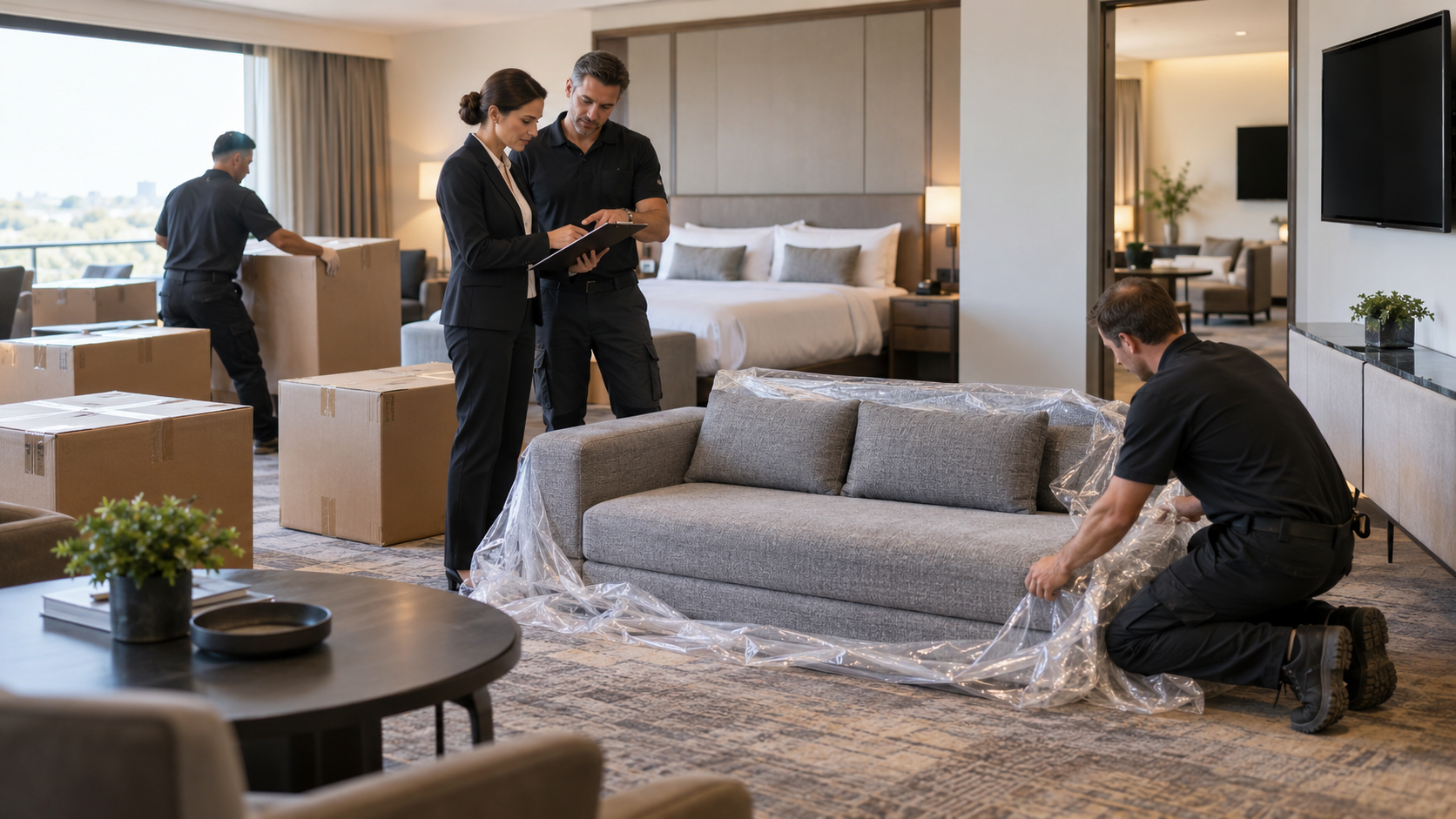
Start with the room turnover window, not the unit price
Hotel operators often have a narrow period between delivery and a high-occupancy sports weekend. Work backward from the guest-ready date. Reserve time for customs clearance, inland delivery, floor-by-floor distribution, unpacking, foam recovery, cover inspection, cleaning, and replacement of any damaged units. A compressed foam sofa that needs up to 72 hours to recover should not arrive the evening before a lounge opens.
Build a room matrix before quotation: doorway and lift clearances, final seating width, circulation space, power-outlet locations, housekeeping access, and the number of units per floor. The compressed sofa collection provides a useful starting point, but the approved model drawing should govern the purchase order.
For a mixed hotel program, buyers should separate guest-room sleeper needs from public-lounge seating. This prevents a visually attractive lounge model from being forced into a room where bed conversion, clearance, or housekeeping access is inadequate.
Verify product parameters against the actual use case
The LS1016 folding compressed sofa bed is listed at 200 × 85 × 70 cm in sofa mode, with a 200 × 215 × 70 cm flat configuration. Its published material is checked velvet fabric, and its carton gross weight is 29.5 kg. Those figures matter operationally: the hotel must confirm the opened footprint, lifting method, floor loading route, and whether two staff members are needed for safe placement.
For a hotel lounge, the L-shape fabric compressed sectional uses fabric upholstery, sponge filling, and D35 seat foam. The supplier describes it for hospitality projects and 3-star through 5-star environments. Ask for a model-specific seat-height and seat-depth drawing, foam-density tolerance, cover construction, seam specification, colorfastness evidence, and an approved fabric swatch. Do not treat a family description such as “velvet” or “fabric” as a complete material standard.
| Procurement check | Published reference | Buyer confirmation before deposit |
|---|---|---|
| Sofa-bed product size | 200 × 85 × 70 cm | Signed drawing and room-clearance test |
| Flat configuration | 200 × 215 × 70 cm | Bed-mode aisle and housekeeping clearance |
| Sofa-bed packing size | 112 × 34 × 35 cm | Carton tolerance and barcode location |
| Gross weight | 29.5 kg per carton | Handling plan and lift capacity |
| Sectional seat foam | D35 | Density tolerance and recovery test method |
| Upholstery | Checked velvet or model-specific fabric | Approved swatch, backing, and performance requirements |
Lock the carton and container assumptions in writing
The LS1016 reference carton is 112 × 34 × 35 cm, or about 0.133 m³, with one piece per carton. The published 40HQ reference is up to 503 units. That is a planning figure, not a guarantee: actual loading depends on final carton tolerance, container internal dimensions, bracing, mixed-SKU ratios, and the loading pattern.
Ask the factory for a carton drawing that identifies compressed product orientation, inner bag, moisture protection, corner protection, label position, gross and net weight, and carton burst-strength requirement. Require a loading simulation for the final SKU mix and compare theoretical quantity with a witnessed trial load. MagiSofa’s container loading support can be used to align carton data, loading sequence, and photo evidence before dispatch.
For seasonal programs, split the order by installation wave when practical. A smaller early batch can validate recovery, fit, color, and housekeeping procedures before the main container is released. This costs planning time but reduces the risk of discovering a systematic issue across every room.

Build a measurable unpacking and recovery test
MagiSofa publishes a target of at least 95% rebound within 72 hours for several vacuum-compressed models. Convert that claim into an acceptance method. Record the sample’s defined reference dimensions before compression, time-stamp unpacking, and measure agreed points at 24, 48, and 72 hours under a controlled room temperature. Photograph seams, corners, cushion height, and symmetry at each interval.
The receiving team should quarantine cartons with punctured vacuum bags, crushed corners, moisture staining, incorrect labels, or abnormal odor. A compressed sofa bed should also be opened, folded, and returned to sofa mode several times during the pilot inspection. For lounge sectionals, connect modules and check alignment on the actual floor finish.
Where the destination market requires specific consumer-product testing or labeling, buyers can use the U.S. Consumer Product Safety Commission as an authority starting point, then confirm the exact standards, test reports, and local legal obligations with a qualified compliance adviser. A generic “certification available” statement is not a substitute for market-specific evidence.
Audit factory capability before scaling the hotel program
The MagiSofa OEM and ODM manufacturing page describes customization for fabric, size, color, label, and packaging. Turn that capability into controlled documents: signed bill of materials, approved golden sample, foam and fabric batch traceability, in-line inspection points, final random inspection level, and corrective-action ownership.
For the LS1016 reference, the published MOQ is 500 units and lead time is approximately 45 days. Buyers should confirm whether that timing begins after deposit, artwork approval, fabric arrival, or sample sign-off. Add a production calendar with hold points for raw-material inspection, first-off approval, compression trial, carton drop or handling tests where required, and container booking.
Also ask the factory to retain one sealed shipment sample and one opened reference sample from the approved batch. If a hotel reports slow recovery or shade variation, those controls make the investigation much faster than relying on photographs alone.
Use a matchday receiving plan to protect guest readiness
Assign every carton to a room, lounge zone, or reserve inventory position before it reaches the property. Barcode labels should match the packing list and floor plan. Deliver cartons close to their final installation zones before opening them, while keeping fire exits and housekeeping routes clear.
Plan a recovery room or protected floor area with ventilation and enough spacing for each sofa compressed in transit to expand without contact damage. Keep spare units from the same production lot available for visible public areas. The hotel team should sign off model, fabric color, dimensions, recovery status, stains, seam quality, and module alignment before the furniture is released for guest use.
For procurement control, include these items in the purchase contract:
- approved product drawing and material schedule;
- carton dimensions, tolerance, gross weight, and one-piece packing rule;
- recovery threshold, measurement points, and maximum time;
- sample approval and production QC records;
- loading plan, container photos, seal number, and packing list;
- spare-unit ratio and remedy for non-recovering or transit-damaged units;
- comments and pingbacks closed on the published project reference page where applicable.
Convert the pilot into a repeatable sourcing decision
The buyer should compare total landed and installation cost, not only factory price. Include ocean freight allocation, port and inland handling, storage, floor distribution, unpacking labor, recovery space, packaging disposal, defect reserves, and the revenue risk of late room release. Vacuum compression can reduce cubic volume, but the saving is real only when the carton data, loading quantity, recovery result, and hotel workflow all hold together.
Use a pilot room and a small lounge zone to approve comfort, appearance, cleaning access, conversion function, and recovery. Then freeze the specification before bulk production. This turns a compressed sofa in a box from a freight idea into a controlled hotel supply program for football-season demand.
Plan Your Hotel Compressed Sofa Program
Share room counts, model mix, delivery window, and destination requirements for an OEM/ODM proposal with carton and container-loading support.
Looking for compressed sofa solutions for a hotel project or apartment supply chain? Contact MagiSofa for bulk orders to review OEM/ODM options, roll-packed sofa specifications, and a model-specific container plan.